From his earliest memories, Marcus believed himself destined by the gods—a creation marked by an almost divine purpose, towering in spirit above others. This belief enveloped his imagination, tying him to legends of old and filling him with awe for the excellence they represented. But his sense of superiority often left him isolated from those who also walked beneath the heavens. Driven by a thirst for glory, he idolized figures like Caesar and Achilles, mirrored Odysseus, and became a student of the ancients. Historians, philosophers, the continuous cultivation of the mind—these were his passions, yet even those closest to him never shared this trait. His idealistic visions left him more and more alone, dreaming of a perfect world he could share, yet ultimately feeling abandoned. Though he hated solitude, he also could not bring himself to connect with those he deemed of a lesser cloth.
Walking through the Florentine countryside—the same soil that bore Machiavelli—Marcus took in the lustrous greenery, the music, and the graceful movement of the women. He admired from afar, believing Providence itself would place him at the center in due time. Beneath the warm sunlight, which bronzed his skin, he watched the carefree women laughing and dancing, reminded of his younger self, before he was consumed by thoughts of the heavens, ambition, and the torments that had cast him into cycles of melancholy. This melancholy shadowed him constantly, an unseen hand pulling him toward despair. He craved a hand to lift him out, yet even those he held closest seemed indifferent to his silent plea, leaving him stranded, abandoned by family, friends, and, it seemed, the world itself.
In surrender to this solitude, Marcus fell into a dull existence that sapped his strength and stole his spirit, driving him to the brink of darkness. Yet, he held onto life out of reverence for his idols, madly convinced they watched over him. Perhaps it was this very madness that kept him from sinking entirely into despair—or perhaps it only anchored him deeper. Still, he clung to life, though he had long abandoned truly living.
One day, as Marcus wandered the busy streets of Florence, captivated by the creations of mankind, he longed to be as carefree and content as those around him. While passing through the bustling bazaar, a woman took an unexpected step backward, falling gracefully into his arms. Their eyes met, and he found himself captivated by the emerald of her gaze, her pale skin, and her ample form. A mademoiselle of rare charm. Her cheeks flushed ruby red, betraying her shyness as she murmured apologies, introducing herself as Petra. The encounter left Marcus enchanted, replaying the moment over and over, imagining all the ways he could have acted, analyzing the outcomes, and chastising himself for not responding as ideally as he wished. He returned to that spot countless times, hoping to catch a glimpse of the goddess he had imagined—a figure of perfection, of warmth and vitality.
It was as if Providence had betrayed him, withdrawing her from his arms, his emotions had torn him from his Destiny, he continued the search for her, never forgetting the eyes she met him with. It was only as the years went by, in which he abandoned his mission, and started existing in the tumultuous world. As he was sitting in Amantium Conventus, Florence’s famed coffee shop, he as usual tried to run away from singularity and surrounded his outskirts with all the joy and simplicity of his environment. It was then he was approached by a Pearly-smile, as he met her green gaze, he instantly found himself witnessing Petra, what a marvel she was! She had remembered him all these years, and called him by name, smiling in her awkward way.
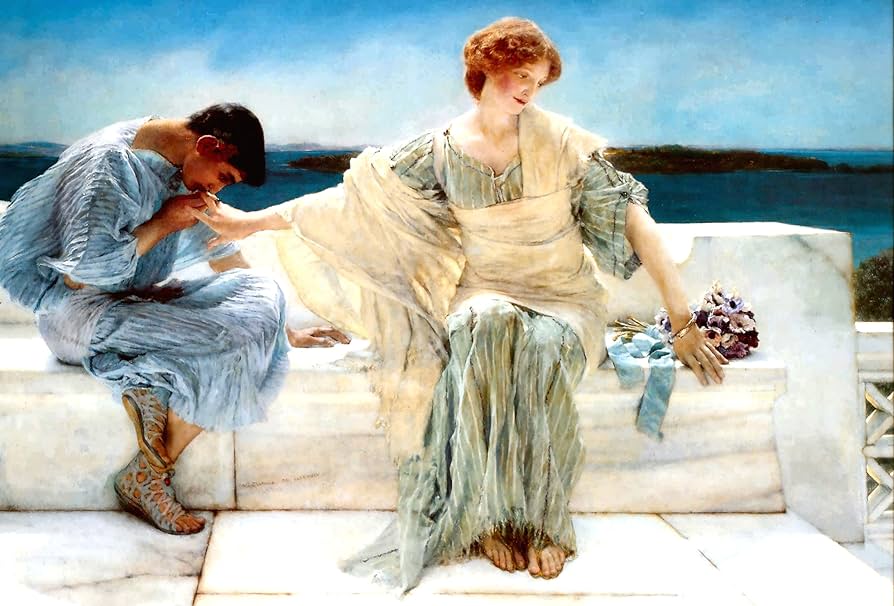
He froze, years of planning had proven ineffective, he had tried to control nature, not knowing nature could control him. Petra had given him a soft kiss on the cheek, flustered by this, he held her hand, smiling back, standing up to reveal his towering stature, and felt the gush of Love strike him. He was an ambitious man, hating harangue and platitudes, which made their first conversation about the philosophy of life, and the future to which Marcus always looked. Marcus had viewed women as a deformed model of Man, of which Prometheus had inperfected. However now, he felt her superiority over him, as she constantly drew him in, he embraced her tug, and allowed himself for the first time, to succumb to the Power of Love.
 Samnehs Blogs